Over recent years, artificial intelligence has reshaped many disciplines, including genealogy. Family historians often ask whether AI can help uncover a great-grandmother’s maiden name or expand a family tree more efficiently. This article examines practical AI uses and limitations for genealogy research in 2025.

Table of Contents
- AI as Your Virtual Genealogy Assistant
- AI Tools for Genealogists in 2025
- What AI Can Do for Your Genealogy Research
- What AI Cannot Do in Genealogy Research
- 💡Genealogy Tip
- Best Practices for Using AI in Genealogy Research
- Should Genealogists Use AI?
AI as Your Virtual Genealogy Assistant
Think of AI platforms as partners that complement your research skills rather than replacing them. As a virtual assistant, AI can accelerate routine tasks and offer fresh perspectives while you retain control of interpretation and verification.
AI complements your genealogy toolkit by:
- Quickly identifying patterns across many documents
- Suggesting records or resources you might have missed
- Brainstorming theories to address brick walls
- Connecting clues that seem unrelated at first
- Drafting readable family narratives from your findings
AI Tools for Genealogists in 2025
Many AI platforms are useful for genealogy. Popular, general-purpose systems and specialized tools can help with planning, problem-solving, and writing. Common platforms include ChatGPT, Gemini, Claude, Microsoft Copilot, and Perplexity. Free tiers often suffice for basic tasks; paid plans may be worthwhile for extended research or advanced features.
Experiment with different platforms to find one that matches your workflow and privacy preferences. Use each tool for its strengths—some excel at brainstorming, others at organizing or summarizing large amounts of text.
What AI Can Do for Your Genealogy Research
AI can earn a place in your genealogy toolkit by improving efficiency and suggesting new directions. Here are four practical ways AI can assist your family history work.
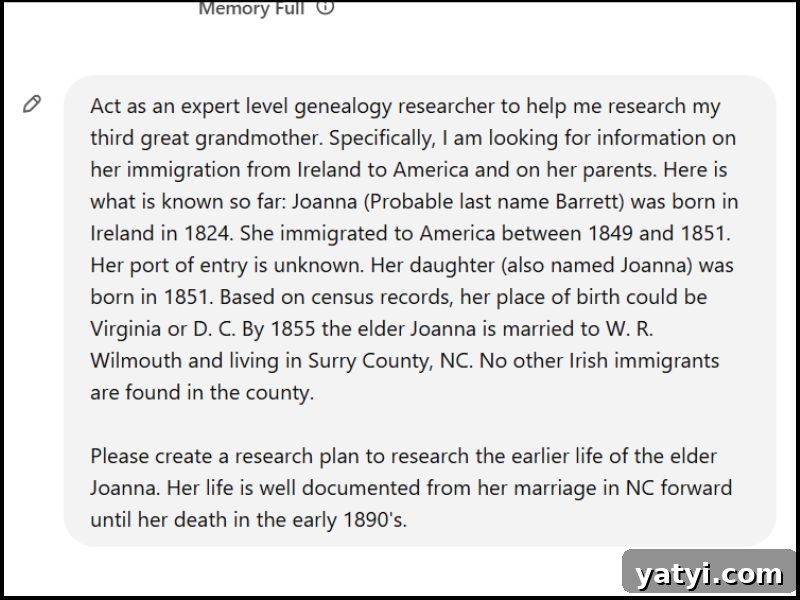
1. Craft Effective Research Plans
A clear research plan saves time and prevents wasted effort. AI can help you structure research projects, list likely record sources, propose search strategies, and prioritize next steps. Plans do not have to be complex—well-focused, step-by-step guidance is often enough to move a project forward.
2. Break Down Brick Walls
AI serves well as a brainstorming partner when you encounter stubborn research problems. By feeding an AI the facts you know, you can ask it to:
- Generate alternative theories for missing or conflicting records
- Suggest overlooked document types or repositories
- Recommend new search angles or jurisdictions to check
- Outline step-by-step approaches to test each hypothesis
Using AI helped me reconsider long-standing puzzles and opened up fresh avenues of research I might not have tried otherwise.
3. Uncover Social History Context
Placing ancestors within their social, economic, and political contexts helps explain life choices and points to relevant records. AI can summarize historical events, suggest how larger trends affected ordinary people, and identify additional source types—such as local newspapers, tax lists, or migration records—that you might pursue.
Contextual insights often reveal which records are most likely to exist for a given time and place, guiding your next research steps.
4. Create Family Narratives
AI can turn scattered facts into coherent stories that engage relatives and preserve family memory. It helps overcome writer’s block, formats narratives for different audiences, and produces drafts you can refine. Well-written narratives make family history accessible to younger generations and to relatives who prefer stories over spreadsheets of data.
What AI Cannot Do in Genealogy Research
AI is a useful assistant but has clear limitations. Recognizing these boundaries prevents misuse and helps you evaluate AI suggestions responsibly.
1. Access Original Records
AI cannot open paywalled genealogy sites, consult physical archives, or retrieve courthouse or local records that require in-person requests. You still need traditional access methods to obtain and verify primary documents.
2. Stay Current with All Sources
Many AI models are trained on data with a cutoff date and may not include the latest publications, newly indexed records, or recent database updates. Always check dates and confirm that suggested sources exist and are current.
3. Replace Your Research Skills
AI cannot substitute for your critical thinking, knowledge of record types, or experience with genealogical methods. It will not automatically understand nuances of local practice, naming patterns, or cultural conventions the way an experienced researcher does.
4. Be Infallible
AI can err or produce fabricated details when uncertain. Verify everything AI suggests by locating original records and cross-checking facts. Treat AI output as a starting point, not a final source.
5. Replace Your “Genealogy Gut”
Experienced genealogists develop instincts about likely family patterns or unusual records. AI lacks that intuitive sense and may miss subtle inconsistencies that alert you to deeper problems. Your judgment remains indispensable.
💡Genealogy Tip
Remember: AI cannot replace you. Use it to complement and enhance your research.
Best Practices for Using AI in Genealogy Research
To get the most from AI, use it strategically. Follow these practical guidelines to produce reliable, useful results.
Guidelines for effective AI use:
- Verify information – Always confirm AI-generated claims with original records and reliable sources. Ask the AI for citations and then track those sources down yourself.
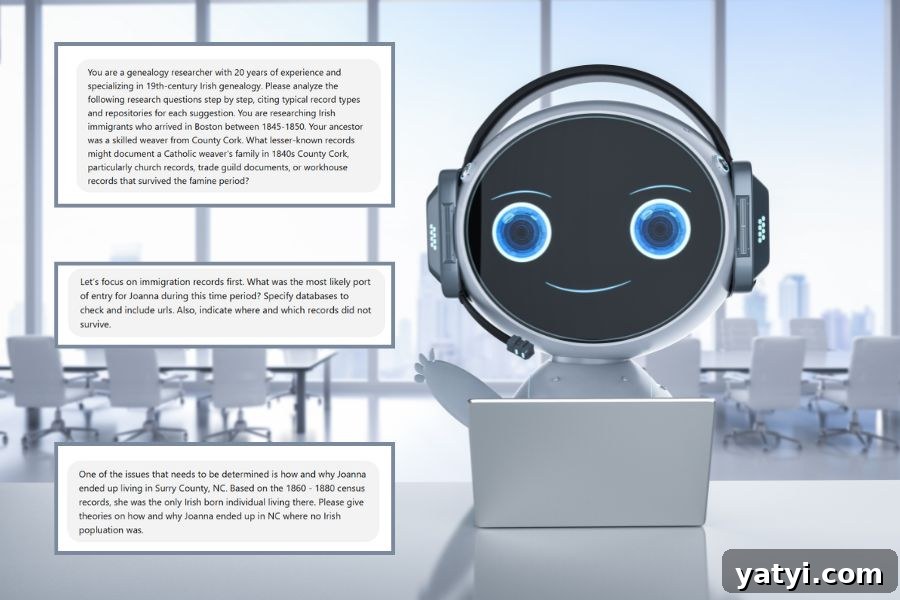
- Be specific with prompts – Detailed prompts produce actionable output. Instead of vague requests, include names, dates, places, and research goals.
- Combine AI with traditional methods – Use AI to complement, not replace, proven genealogical techniques such as repository searches, record analysis, and source citation.
- Stay current with tools – AI features and integrations evolve rapidly. Watch for improvements in transcription, image analysis, and database connectivity that can benefit genealogy.
Should Genealogists Use AI?
Yes. When used thoughtfully, AI saves time, helps organize research, suggests new approaches, and turns data into stories. The best results come from combining AI’s strengths with your knowledge, critical thinking, and experience.
AI is a powerful tool for genealogy—not a replacement for your skills. Understand its capabilities and limits, verify suggestions, and incorporate AI into a methodical research process to make meaningful family history discoveries.